
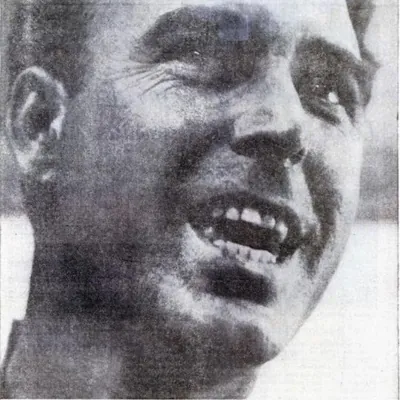
Photo: Columbia Records / Photographer not credited, Public domain, via Wikimedia Commons.
Johnny Horton
Johnny Horton, a country singer originally from Los Angeles, California, found his greatest fame with a string of historical saga songs that topped the charts in the late 1950s. His biggest hit was "The Battle of New Orleans," which won a Grammy and became one of the best-selling country singles of its era. He was killed in a car crash in 1960, cutting short a career that bridged honky-tonk and folk storytelling.
Start here
The Spectacular Johnny Horton (1959). It gathers his two signature hits, "The Battle of New Orleans" and "When It's Springtime in Alaska (It's Forty Below)," along with other songs that showcase his knack for turning history into catchy country narratives.
Biography
John LaGale Horton (April 30, 1925 – November 5, 1960) was an American country, honky tonk, and rockabilly musician during the 1950s. He is best known for a series of history-inspired narrative country saga songs that became international hits. His 1959 single "The Battle of New Orleans" was awarded the 1960 Grammy Award for Best Country & Western Recording. The song was awarded the Grammy Hall of Fame Award and in 2001 ranked number 333 of the Recording Industry Association of America's "Songs of the Century". His first number-one country song was in 1959, "When It's Springtime in Alaska (It's Forty Below)".
Horton had two successes in 1960 with both "Sink the Bismarck" and "North to Alaska", the latter used during the opening credits of the John Wayne film. Horton died in November 1960 at the peak of his fame in a traffic collision, less than two years after his breakthrough. He is a member of the Rockabilly Hall of Fame, the Louisiana Music Hall of Fame, and in 2025 the Texas Country Music Hall of Fame.
From Wikipedia, licensed under CC BY-SA. Read the full article.
Studio albums
Discography
Official studio albums and EPs.
- 19874 PlayEP
- 1985Back HomeAlbum
- 1983The Original Outlaws Johnny Horton & FriendsAlbum
- 1970The Legendary Johnny HortonAlbum
- 1969On the RoadAlbum
- 1966All Star WesternsAlbum
- 1966Johnny Horton on StageAlbum
- 1965I Can’t Forget YouAlbum
- 1965The Best of Johnny HortonEP
- 1965I Can’t Forget YouEP
- 1961Johnny Horton’s MemoriesAlbum
- 1961Johnny Horton’s Greatest HitsEP
- 1961Le grand SamEP
- 1961Honky-Tonk ManAlbum
- 1961Sleepy-Eyed JohnEP
- 1960Johnny Horton Makes History (Action Tales of Battles, Heroes, and Epic Events)Album
- 1960Johnny Horton Makes History, Volume IIEP
- 1960The Fantastic Johnny HortonEP
- 1960The Battle of New OrleansEP
- 1960Johnny Horton Makes History, Volume IIIEP
- 1960North to AlaskaEP
- 1960Johnny Horton Makes HistoryEP
- 1959The Spectacular Johnny HortonAlbum
- 1959Country and Western AcesEP
- 1959The Battle of New OrleansEP
- 1959The Battle of New OrleansEP
- 1959North to AlaskaEP
- 1959More Johnny Horton Specials-America’s Most Creative Folk SingerAlbum
- 1959Country and Western SongsEP
- 1959Free ’n’ Easy SongsEP
- 1959Sings Free and EasyAlbum
- 1959The Spectacular Johnny Horton, Vol. 2EP
- 1959The Big Hits!EP
- 1959Western SongsEP
- 1959The Spectacular Johnny Horton, Vol. 1EP
- 1959The Spectacular Johnny Horton, Vol. 3EP
- 19584 Big Hits!EP
- 1957Honky-Tonk ManEP
- 1953Red Lips and Warm Red WineEP
Latest news
No news stories yet.