
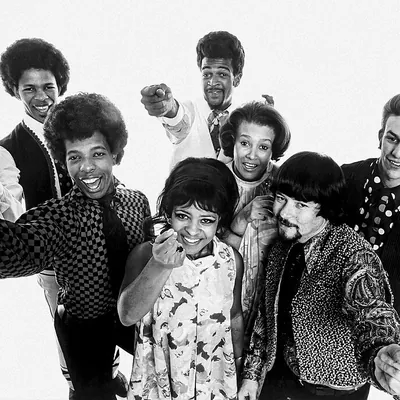
Photo: Distributed by Epic Records, Daedalus Management, and William Morris Agency, Inc. Photographer uncredited and unknown., Public domain, via Wikimedia Commons.
Sly and the Family Stone
Sly and the Family Stone came out of San Francisco in the late sixties with something nobody else had: a mixed-race, mixed-gender band that made funk, rock, and pop feel like one thing. Songs like "Dance to the Music," "Everyday People," and "Thank You (Falettinme Be Mice Elf Agin)" became chart hits, and the group's horn-driven, bass-heavy sound set the template for just about all the funk and disco that followed.
Start here
Stand! (1969). It catches the band at its most joyful and confident, with "Everyday People," "Sing a Simple Song," and the title track all on one record. "I Want to Take You Higher" shows how much energy they could pack into a single song.
Biography
Sly and the Family Stone was an American band formed in San Francisco, California, in 1966 and active until 1983. Their work, which blended elements of funk, soul, psychedelic rock, gospel, and R&B, became a pivotal influence on subsequent American popular music. Their core line-up was led by singer-songwriter, producer, and multi-instrumentalist Sly Stone, and included Stone's siblings Freddie Stone (guitar, vocals) and Rose Stone (keyboard, vocals) alongside Cynthia Robinson (trumpet, vocals), Greg Errico (drums), Jerry Martini (saxophone), and Larry Graham (bass, vocals). The band was the first major American rock group to have a racially integrated, mixed-gender lineup.
Formed in 1966, the group synthesized a variety of musical genres to pioneer the emerging "psychedelic soul" sound. They released a series of Top 10 Billboard Hot 100 hits such as "Dance to the Music" (1968), "Everyday People" (1968), “Hot Fun in the Summertime” (1969), and "Thank You (Falettinme Be Mice Elf Agin)" (1969), as well as critically acclaimed albums such as Stand! (1969), which combined pop sensibility with social commentary.
From Wikipedia, licensed under CC BY-SA. Read the full article.
Studio albums
Discography
Official studio albums and EPs.
- 1983Ain’t but the One WayAlbum
- 1979Back on the Right TrackAlbum
- 1976Heard Ya Missed Me, Well I’m BackAlbum
- 1974Small TalkAlbum
- 1973FreshAlbum
- 1971There’s a Riot Goin’ OnAlbum
- 1969Stand!Album
- 1968LifeAlbum
- 1968Dance to the MusicAlbum
- 1967A Whole New ThingAlbum
Latest news
No news stories yet.