
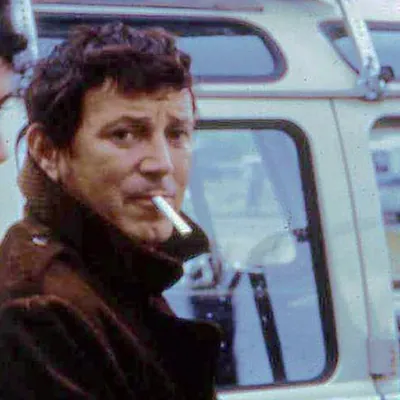
Photo: Roland Godefroy, CC BY-SA 3.0, via Wikimedia Commons.
Gene Vincent
Gene Vincent was barely out of his teens when he cut "Be-Bop-a-Lula" in 1956 with his band the Blue Caps, and the record became one of the defining singles of early rock and roll. The rest of his career never quite matched that first flash: a 1960 car crash in England, the same one that killed Eddie Cochran, left him with a permanently damaged leg, and he died in 1971 at just 36. But the hiccupping vocal and echo-heavy guitar of that first hit never really went away, and "Be-Bop-a-Lula" has been covered and loved by generations of singers who grew up on it.
Start here
Sounds Like Gene Vincent (1959). A late-fifties Capitol set that shows what he could do beyond the hit single, moving between rockers and slower material like his takes on "Summertime" and "Over the Rainbow." It's a good picture of the voice and the backing sound that made him stand out in the first place.
Biography
Vincent Eugene Craddock (February 11, 1935 – October 12, 1971), known as Gene Vincent, was an American rock-and-roll musician who pioneered the style of rockabilly. His 1956 top-10 hit with his backing band the Blue Caps, "Be-Bop-a-Lula", is considered a significant early example of rockabilly. His chart career was brief, especially in his home country of the US, where he notched three top-40 hits in 1956 and 1957 and never charted in the top 100 again. In the UK, he was a somewhat bigger star, racking up eight top-40 hits from 1956 to 1961.
Vincent was inducted into the Rock and Roll Hall of Fame and the Rockabilly Hall of Fame. He is sometimes referred to by his somewhat unusual nickname/moniker, the "Screaming End".
From Wikipedia, licensed under CC BY-SA. Read the full article.
Studio albums
Discography
Official studio albums and EPs.
- 2015The Crazy Beat Of Gene VincentAlbum
- 1992Am I That Easy to ForgetAlbum
- 1988Into the SeventiesAlbum
- 1987BebopalulaAlbum
- 1987The Last SessionEP
- 1982Dressed in BlackAlbum
- 1980Rainyday SunshineEP
- 1979Rhythm In BlueAlbum
- 1977Les plus grands noms du RockAlbum
- 1972Memorial AlbumAlbum
- 1970Gene VincentAlbum
- 1970The Day the World Turned BlueAlbum
- 1969I'm Back and I'm ProudAlbum
- 1967Born to Be a Rolling StoneAlbum
- 1964Shakin’ Up a StormAlbum
- 1960Crazy TimesAlbum
- 1959Sounds Like Gene VincentAlbum
Latest news
No news stories yet.