
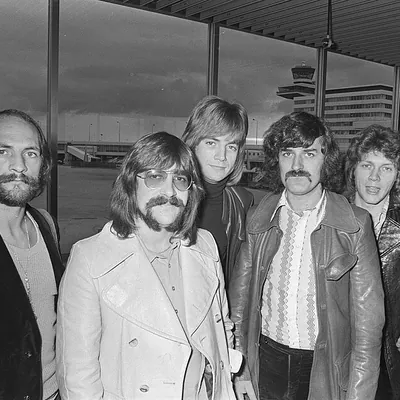
Photo: Nationaal Archief, Den Haag, Rijksfotoarchief: Fotocollectie Algemeen Nederlands Fotopersbureau (ANEFO), 1945-1989 - negatiefstroken zwart/wit, nummer toegang 2.24.01.05, bestanddeelnummer 923-9509, CC0, via Wikimedia Commons.
The Moody Blues
The Moody Blues came out of Birmingham in the mid-1960s, first scoring a hit with the R&B-flavoured "Go Now" before reinventing themselves entirely. By 1967 they had fused rock with orchestral arrangements on Days of Future Passed, a concept album built around a single day that produced "Nights in White Satin," and that lush, thoughtful sound carried them through a long run of albums into the early 1970s and beyond. Their blend of rock with symphonic textures helped open the door for progressive rock, and "Nights in White Satin" remains one of the most recognisable songs of its era.
Start here
Days of Future Passed (1967). Days of Future Passed (1967) is where the band found the sound that defined them: rock songs woven together with orchestral interludes. It has "Nights in White Satin" and "Tuesday Afternoon," and it plays as one continuous piece from dawn to nightfall.
Biography
The Moody Blues were an English rock band formed in Birmingham in May 1964. The group initially consisted of Graeme Edge (drums), Denny Laine (guitar/vocals), Mike Pinder (keyboards/vocals), Ray Thomas (multi-instrumentalist/vocals) and Clint Warwick (bass/vocals). Originally part of the British beat and R&B scene of the early-to-mid-1960s, they came to prominence with the UK No. 1 and US Top 10 single "Go Now" in late 1964/early 1965. Laine and Warwick both left the band in 1966, with Edge, Pinder and Thomas recruiting new members Justin Hayward (guitar/vocals) and John Lodge (bass/vocals). They embraced the psychedelic rock movement of the late 1960s, with their second album, Days of Future Passed (1967), a fusion of rock with classical music (performed with the London Festival Orchestra). It has been described as a "landmark" in the development of art rock and progressive rock, and "one of the first successful concept albums".
From Wikipedia, licensed under CC BY-SA. Read the full article.
Studio albums
Discography
Official studio albums and EPs.
- 2003DecemberAlbum
- 1999Strange TimesAlbum
- 1991Keys of the KingdomAlbum
- 1988Sur la merAlbum
- 1986The Other Side of LifeAlbum
- 1983The PresentAlbum
- 1981Long Distance VoyagerAlbum
- 1978OctaveAlbum
- 1972Seventh SojournAlbum
- 1971Every Good Boy Deserves FavourAlbum
- 1970A Question of BalanceAlbum
- 1969To Our Children’s Children’s ChildrenAlbum
- 1969On the Threshold of a DreamAlbum
- 1968In Search of the Lost ChordAlbum
- 1968Juvenes en la tardeEP
- 1967Days of Future PassedAlbum
- 1966I Go Crazy / I Had a Dream / From the Bottom of My Heart / And My Baby’s GoneEP
- 1965The Magnificent MoodiesAlbum
Latest news
No news stories yet.